We raced 984 TradingView alert orders through two paths. The winner was 511ms faster.
Measured from live trades on Tradovate. No simulations, no cherry-picking.
Anyone automating TradingView alerts knows the feeling. The alert fires, you wait, and somewhere in that gap between signal and fill you wonder how much the market just moved without you. It’s like throwing a dart at a board that’s sliding sideways.
The longer your arm takes to release, the further the bullseye drifts.
Most tools promise “fast” or “real-time” execution, but they never show you the math on what that actually looks like. We decided to measure it.
For one week, we ran 984 trades through two alert execution paths at the same time: our browser extension and our webhook relay. Both paths raced to Tradovate on every single alert. Whichever arrived first got the fill. The slower one was discarded.
We logged everything.
Two Paths, Racing on Every Alert
Tikitrade is the first webhook platform to use dual-path execution. When a TradingView alert fires, the order travels two routes simultaneously:
- Browser Extension – a direct connection from your TradingView browser tab to Tradovate
- Webhook – a cloud relay from TradingView to our servers to Tradovate
The first one to reach Tradovate executes the order. The other is ignored. Think of it like taking two different routes to work at the same time. Most mornings the highway is faster, but some days there’s a backup and the side streets win.
You don’t pick one and hope – you take both and arrive whenever the first one gets there.
No single path is always fastest. This is because under the hood, TradingView delivers alerts through a message queue. During busy times, some messages might get delayed as the queue works to send to thousands of recipients, including their mobile app, webhook systems, and their browser app.
They all share the same queue! This is why sometimes your browser is quicker and other times the cloud is. Running both pipelines means the order always takes whichever route gets there first.
The Results: 984 Races
| Path | Win % | Median Edge | Max Edge | Min Edge |
|---|---|---|---|---|
| Extension | 72% | 511ms | 2,723ms | 20ms |
| Webhook | 28% | 302ms | 3,803ms | 21ms |
| Overall | 100% | 434ms | 3,803ms | 20ms |
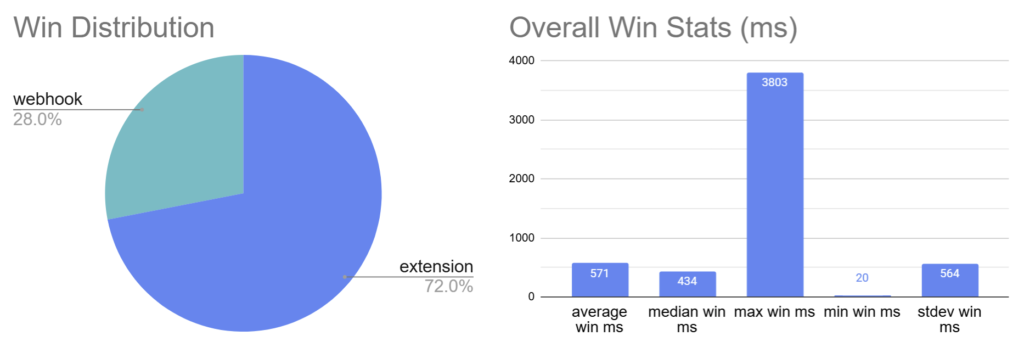
The extension won 3 out of 4 races, typically by just over a half second, 511ms. The webhook won the other quarter, typically by 302ms. Across all 984 trades, the winning path beat the losing path by a median of 434 milliseconds! That’s the window where the market can move against you on every single fill.
What 434ms costs you
On ES futures, 400ms of price movement can mean 2-4 ticks, or $25 to $50 per contract. At 5 contracts, that’s $125 to $250 per trade. Over 100 trades in a month, it adds up to $12,500 to $25,000 in potential slippage. Even on smaller size or slower instruments, shaving 400ms off your execution means tighter fills, less slippage, and live results that actually resemble your backtests.
How each path behaves
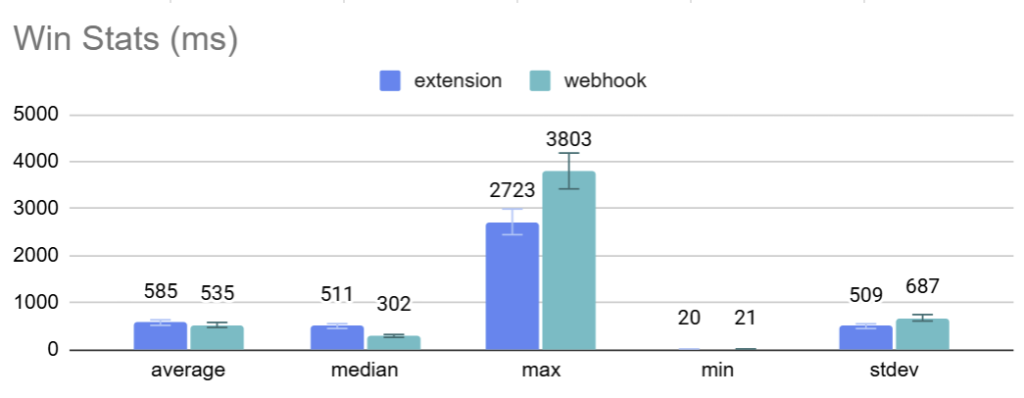
The extension is the workhorse. When it wins (72% of races), it beats the webhook by a median of 511ms with consistent performance (509ms std dev). It runs locally, connects directly, and generally wins by a comfortable margin.
The webhook is the safety net. When it wins (28% of races), it beats the extension by a median of 302ms, but with higher variability (687ms std dev). The webhook tends to win when something hiccups locally: a browser freeze, a CPU spike from a background tab, a momentary network blip. In those moments, instead of eating a 500ms+ delay, the webhook gets your order through in around 300ms.
What single-path users would have lost
Looking at the 984 trades, if you only had the extension, 276 trades would have been 300 ms+ slower. If you only had the webhook, 708 trades would have been 500 ms+ slower. With both paths racing, the faster path won every single time. Neither path is perfect on its own but dual-path missed the fastest route zero times out of 984.
The wide variability of delays
The histogram below shows where the bulk of races land. While 1 out of 3 trades fall under 200ms, notice that nearly 1 in 2 trades (47%) happen between 200ms and 1000ms. The remaining 18% (1 in 5) of trade delays are greater than a second!
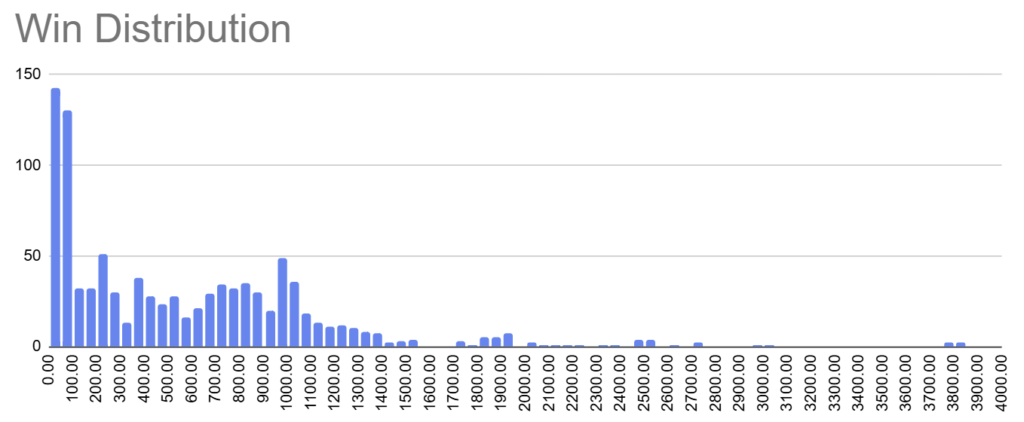
This picture shows the reality of how volatile delays are, and why our dual-path approach is necessary.
How This Compares to Single-Path Solutions
The vast majority of TradingView-to-Tradovate automation tools rely on just one execution path — either a webhook or a browser extension.
Our 984-trade study shows that single-path systems take the slower route 72% of the time with no fallback option.
Here’s how the approaches stack up:
| Feature | Typical Webhook-Only | Typical Extension-Only | Tikitrade (Dual-Path) |
|---|---|---|---|
| Monthly Price | ~$99 | ~$65 | $34 (founders rate) |
| Execution Paths | 1 (webhook only) | 1 (extension only) | 2 – always takes the fastest |
| Voice Alerts | No | No | Yes |
| 100+ Premium Indicators | Costs Extra | No | Yes |
| Unlimited Copier Groups | Sometimes | No | Yes |
| News Protection | No | No | Yes |
Key takeaway from the data: Any single-path tool (webhook or extension) would have been on the slower path for 72% of the 984 live trades we recorded.
That means on hundreds of those trades, the trader using a single-path system had no idea a faster route existed — and simply ate the extra 434 ms median delay (2–4 ticks on ES/NQ).
Dual-path execution changes that forever: every alert fires both routes simultaneously, the faster one wins, the slower one is ignored. Zero times out of 984 did we lose the speed battle.
Pricing reality Tikitrade launched at a founders rate of $34/month. This will increase to $55/month as we grow (still well below typical single-path pricing). Only 55 founder spots remain at this rate.
Lock in the $34 rate now and you keep it forever, even as we add more indicators, copier groups, and features.
How We Collected This Data
These are real trades from live Tradovate accounts, not a synthetic benchmark.
- 984 consecutive TradingView alerts over one week
- Both execution paths ran simultaneously on every alert
- Winner determined by local timestamp (millisecond precision)
- Recorded the moment Tikitrade received the alert from either path
- No filtering, no cherry-picking
Conditions and limitations: Data was recorded from a single trader’s setup (one machine, one network, one location). Over our one-week sample window, even after the first 300 or so trades, a pattern emerged and became clear: racing two paths consistently outperforms relying on one.
See the raw data: We’ve published the full dataset so you can check the numbers yourself. View the spreadsheet.
Run your own analysis: Tikitrade members can download timing data from the Webhook Alerts panel to see the timing deltas when running both paths. Use it to tell your friends about the results you are getting.
Try it for free
If you’re on a single-path tool right now, there’s no way to know how often the other path would have been faster. It’s like driving the same route to work every day without ever checking Waze. Maybe it’s the fastest way. Maybe you’re sitting in traffic that doesn’t exist two blocks over.
Start a free 30-day trial and run both paths using a test Webhook. Our entry Ohana membership includes a full month trial, no commitment. When ready, upgrade to Kahuna and lock in the founders rate before it’s gone.
About This Study
This research was conducted by Tiki Dave, founder of Tikitrade, using live trading data from January 2026. All trades were executed on Tradovate accounts. Performance data represents execution speed, not trading profitability. Past performance does not guarantee future results. Results may vary based on network conditions, broker latency, and market conditions.
For questions or technical details, contact us or join our Discord community after starting your trial.